
If you have a learning disability, you will know what I mean. If you do not, then you can empathize and understand.
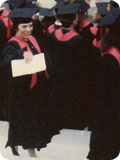
Karen graduating from college
When I was six years old, I couldn’t even tell my teacher what the story we had just read in class meant. This was difficult and devastating for me. It haunted me.
In the back of my mind, I asked myself, “Why is this happening to me? Why is this so difficult? Why can’t I remember? And why can’t I keep the information I just read in my mind?“
It didn’t just bother me; it made me feel stupid. And that hurt me deeply.
I couldn’t retrieve the storyline from my memory, nor could I assemble it in my mind’s eye. I couldn’t even recall the information to tell my teacher.
But I knew I was smarter than that. Every morning I stood up from my seat, moving in a happy, lively way up to the green board. I took the white chalk in my strong, right, lion-hand and wrote my girlfriend’s last name on the board.
When I was done, I returned to my seat with the biggest grin on my face. It felt so good. And I felt really proud of myself.
“At least I can do that,” I told myself, in a nurturing way. I felt confident.
Yet, after twelve years of education in elementary and high schools dedicated to students with disabilities—twelve years of learning almost nothing—and having to win a civil rights case so I could go to college when I was twenty-eight years old, a friend and mentor taught me how I could read, write, and comprehend while listening to non-vocal music.
This method accompanied me through Chaucer’s Sir Gawain and the Green Knight, William Wordsworth’s “A Farewell,” and F. Scott Fitzgerald’s The Great Gatsby
All this reading became possible because of my mentor, Robert. His suggestion to put on music while reading became a constant companion. This tool gave me the freedom to read and became my trusted friend.
I read because I enjoyed reading, not because I was forced to or had to for classes. When I read, I felt safe. Reading helped fill the gaps in my education, and it answered my questions. Most importantly, it made me knowledgeable and well-informed.
Comfortable and at ease when I sat down in my happy chair under my cozy blanket, I didn’t have to worry about all the pages I had to finish like I did as an eight-year-old in the library. Instead, I read for enjoyment.
And if I got nervous, I told myself, ”Just read one page at a time. You’ll be fine, sweetheart. Enjoy it. Embrace it. Relax into it. Imagine what wonderful things you’ll learn, Karen.”
As a result, reading felt like gentle stars dropping from heaven above, bringing me peace and calm. It gave me exactly what I needed to grow through this challenge.
The biggest benefit of listening to non-vocal music while reading was that I remembered what I read. I closed my eyes and visualized what the author had said. And, best of all, I could tell my mentor what the story was about.
“I am recalling what I just read,“ I declared, like a child jumping up and down. I was filled with hope and enthusiasm. I was doing this for the very first time in my life. I was thirty-five years old, but age didn’t matter. I was thrilled beyond belief at what I was accomplishing. No matter my age, I was doing it! I did this!
I said to myself with great happiness and exhilaration. “I feel very accomplished that I kept at it—my dream to read has become a dream come true.”
Even bigger, I was yet more motivated and thirsty to learn. After all those years, reading was attainable now. And so palpable was my desire to understand every book I could get my hands on—more knowledge—more than I ever thought I was capable of before. Now I have a library of my own—books that I can proudly say I’ve read.
How many countless hours have you spent trying to read a book, a sentence, or a paragraph? Could you understand a word that you just read.? Could you explain it?
I know exactly what that feels like. I have spent a lifetime finding a way to learn to read that worked for me.
If I can learn to read, you can learn to read, too!
Did this ever happen to you?
Leave a Reply