
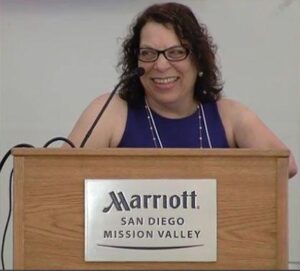
Karen delivering an inspiring keynote at a People First conference
This has been the story of my life. No matter how much effort I put into my work, I have been harassed, intimidated, and misused by authorities, outfaced and stared down by co-workers, and intimidated by their icy gaze. This was throughout my twenties.
For instance, when I was twenty-five years old, I worked for a disability organization, teaching other disabled people chair aerobics and leading recreational activities. One day, I was heading down the hall to use the restroom when my supervisor mimicked my left leg’s limp. Looking up in disbelief, my heart sank. Offensive as that was, this unkind soul made fun of my left arm, too. I was sick to my stomach. He was savage, uncivilized, vicious, and brutal. Uncouth, to say the least.
How could I not be upset? At that moment, I nurtured myself, whispering, “Just be gentle with yourself, darling. You can face this. You are courageous and dauntless.”
I began releasing my stress by letting out a quiet, haunting, lingering sound. Though filled with horror and shock, I remained unflappable under immense pressure. I was immutable—ironclad—secure in my thoughts, and would not be undermined. These were obvious acts of ableism.
A few minutes later he called me into his office, talking about my wing. I said, “Do you mean my left arm?”
He answered, “Yes. Your broken wing.”
I was mortified, but again, rock-solid. With a stable foundation, I left his office with my head held high.
We all envision ourselves in a certain way. We dream of becoming different things in life, of taking on fresh challenges. The phrase “perchance to dream” comes from Hamlet, Act 3, scene 1. This is the famous scene that begins with “To be or not to be—that is the question…” In the reading of this play, the words replayed in my mind, wrapping me rhythmically, as I knew I had a choice to make. Was I going to use my ability to grow, or was I going to wither in my fears? As a person with cerebral palsy and a learning disability, was I going to listen to an ableist or was I going to become more open-minded, and willing to change for the better? Was I going to accept new possibilities, spark my chance to grow, and believe in myself? Was I going to encourage and motivate myself? Or was I going to submerge all of myself, and my hopes and dreams to improve myself and my life? And, lastly,, was I going to boost my confidence to become more independent, self-sufficient, and flexible in thought-provoking events, while getting involved actively and experiencing society by participating in activities and events.
Imagine, then, if you spent your whole life pouring countless hours, hard work, and energy into trying to prove yourself? That is what many people face every day—including me. This is called ableism. It also means creating a false and negative image of one’s being. You might say to yourself that you are not being authentic. It’s not being honest or real. Ableists are extremely clever at convincing someone to agree with them and to act accordingly by giving reasons that seem believable on the surface.
In this way, one is not able to self-direct. Ableists think less of you and are very unfair. They use words like “dumb” and “stupid.” They claim people with disabilities are unable to achieve a self-guided and independent life. There are two types of ableism:
• Physical: “You’re too handicapped to work here.”
• Mental: “You’re overqualified for this job. You have too much experience to work for our company.”
Outright discrimination is more obvious. Remember, ableism is not always obvious. Ableists specifically exclude disabled people, but they may do it with a phony smile.
People underestimate the impact of their words and actions. People make fun of what they don’t understand until they have to go through it themselves. I can go on telling you more stories, but it is too harsh, too painful, and in a dark, dissonant tone. Even though I faced these experiences of discrimination, I had to stay positive and turn my attitude around. I had to find my peace of mind and send tranquil thoughts to those who tried to harm me. I would not let these people win. I became a better person for facing and living through each one of these cruelties. With an acceptance and a courage that wouldn’t quit. Fearlessly, I moved on. I found forgiveness.
After a lifetime of being ableised and discriminated against, there is nothing anyone can say that could harm me. The mental act and practice of this unfair treatment have gone too far. It’s cruel, unfair, and demoralizing. Sometimes even leading to death.
I hope my words leave you understanding that you too can get through this. That someone before you walked down the same path and can hold you and lift you up.
Has ableism touched your life? Would you care to share with all of us your hope and light?
Text and image ©2026 by Karen Lynn-Chlup. All rights reserved.
Leave a Reply